Went to the Big Word Slam for the first time in my life last night. Does it surprise you that I was a slam virgin? Well, in the general run of things, Thursdays are not convenient evenings for me. And although I love poetry readings, I’ve never been convinced by performance poetry as a genre*. Nonetheless, I thought I’d give it a shot, in part because Jennifer Williams was competing. (If I’d have tagged her as anything, it would have been more as a slightly experimental poet than a performance poet, but blurring the distinctions ain’t a bad thing.)
In one important sense, I remain a slam virgin, since I went as an audience member not a slammer. Don’t think I’m likely to be hurrying back, though: I was largely underwhelmed by the quality of writing on display. I don’t want to hear another -ation rhyme for years. Or possibly ever. Any Tom, Dick or Harry can rhyme anything ending in -ation and the choice is wide, if largely abstract, so a string of such rhymes is little demonstration of skill, craft and creativity.
Last night illustrated what I see as a big problem with slams: third-rate writing can be hidden too easily behind an energetic, audience-pleasing performance whereas good writing that comes with a quieter performance can suffer, no matter how assured the delivery. It’s written into the rules at Big Word, where the judges are supposed to score on each of three aspects: the quality of the writing, the performance and the audience reaction. Democracy is a great way to run a country, but I’m not sure how good a way it is to run a poetry event. Though the fact that the judges have hardly any breathing space to formulate their judgments and scores on one heat before the next begins might mitigate even more against a just outcome.**
Of course, it’s not that a really good writer can’t share a brain and body with an energetic performer, just that there was little evidence of it in what I saw yesterday***. A loud and lively performance is fine and dandy, but there has to be electricty in the language as well. Otherwise why call it poetry? Nor is it that the quieter writing doesn’t stand a chance, but the odds are stacked against it when the quality of the writing is only one criterion in three.
I mentioned JL Williams; I’ve been impressed by her work and readings in the past and, even if last night’s poem wasn’t her best by a long stretch, she deserved to go through to the semi-final more than some of the slammers who did. Personally, I think she suffered from not being noisy enough, but that’s not her style. Her delivery has a fine measured, mesmeric quietness. That stood out, but it obviously didn’t please enough.
However, nick–e melville, whose poem for the heats was constructed of phrases taken from television adverts, was way out in front. It wasn’t only the writing technique that distinguished him, but the humour and intelligence of the composition. Oh, there was plenty comic writing on offer throughout the heats, as you might anticipate, but there was nothing else that managed to be simultaneously so entertaining, clever, intelligent and stimulating. He was a good reader too, and I kind of regret not sticking around to hear what else he had to read. On last night’s showing and the work you’ll find if you follow the links in his name above, I wouldn’t peg him as a performance poet at all. I’d say he’s more of a concrete, visual or experimental poet so, if I spot him on a future bill, maybe I will go back.

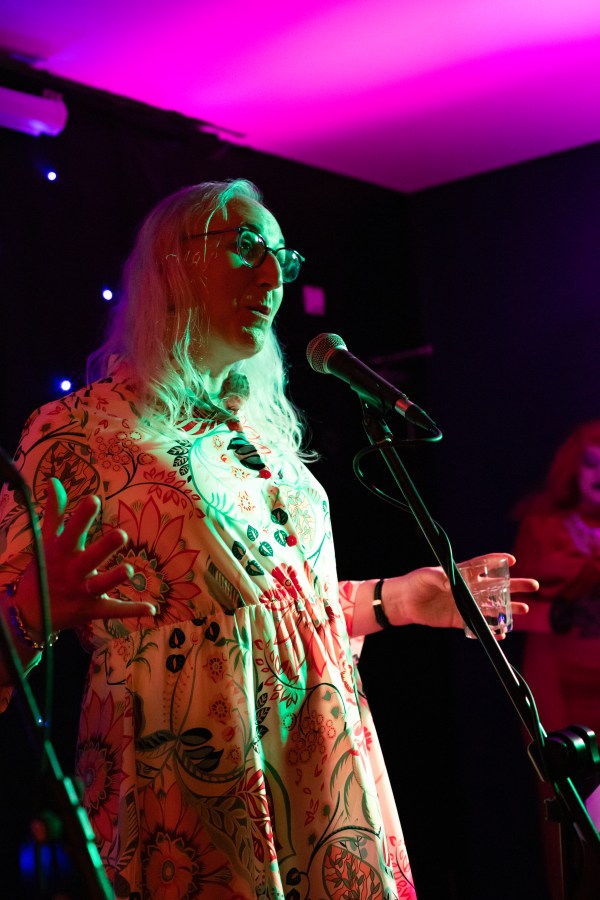
 Amy Jo Philip
Leave a reply to Colin Will Cancel reply